
Contents
Overview
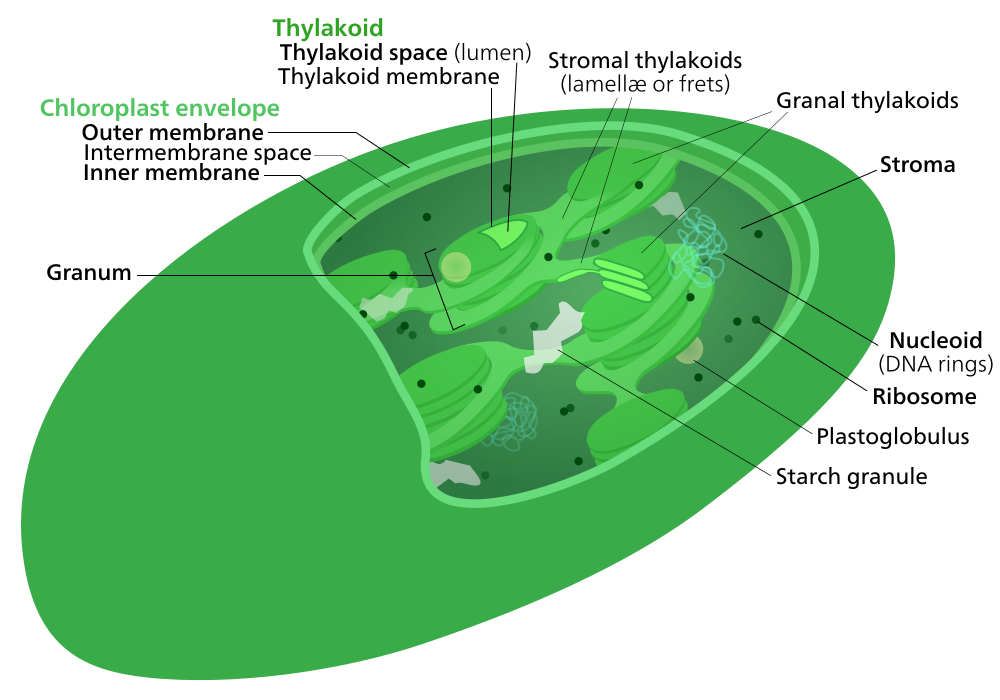
The Calvin cycle, also known as the light-independent reactions or the photosynthetic carbon reduction (PCR) cycle, is a fundamental biochemical pathway essential for life on Earth. This series of reactions occurs within the stroma of chloroplasts in plants and algae. It utilizes the energy captured during the light-dependent reactions of photosynthesis. Specifically, it converts atmospheric carbon dioxide (CO2) into glucose, a vital sugar molecule that fuels cellular processes and forms the building blocks for plant growth. The cycle is not a single reaction but a complex, multi-step process involving enzyme-catalyzed transformations that regenerate its starting molecule, ensuring continuous carbon fixation. Its efficiency and regulation are critical for global carbon cycles, agricultural productivity, and the very air we breathe, making it a cornerstone of biological energy conversion.
🎵 Origins & History
The Calvin cycle's discovery is intrinsically linked to the broader understanding of photosynthesis. While early work by scientists like jan ingenhousz in the late 18th century established that plants use light to produce oxygen and organic matter, the specific biochemical pathways remained elusive for over a century. The crucial breakthrough came in 1954 when the cycle was elucidated using radioactive carbon-14 (¹⁴C) as a tracer. This groundbreaking work earned melvin-calvin the Nobel Prize in Chemistry in 1961, solidifying the cycle's place in biological science and providing a foundational understanding of carbon assimilation in photosynthetic organisms.
⚙️ How It Works
The Calvin cycle operates in three distinct phases, all occurring within the chloroplast stroma. Phase 1, carbon fixation, involves the enzyme rubisco catalyzing the attachment of CO2 to a five-carbon sugar, ribulose-1,5-bisphosphate (RuBP), forming an unstable six-carbon intermediate that immediately splits into two molecules of 3-phosphoglycerate (3-PGA). Phase 2, reduction, uses ATP and NADPH generated during the light-dependent reactions to convert 3-PGA into glyceraldehyde-3-phosphate (G3P), a three-carbon sugar. For every six molecules of G3P produced, one molecule exits the cycle to be used for synthesizing glucose and other organic compounds. Phase 3, regeneration of RuBP, consumes the remaining five G3P molecules and more ATP to regenerate three molecules of RuBP, allowing the cycle to continue. This intricate process ensures that CO2 is continuously captured and converted into usable energy.
📊 Key Facts & Numbers
The Calvin cycle is the bedrock of most food webs on Earth. For every three molecules of CO2 fixed, nine molecules of ATP are consumed, and six molecules of NADPH are utilized, resulting in the net production of one molecule of G3P. This G3P can then be converted into glucose (C6H12O6) and other carbohydrates. In C3 plants, which represent about 90% of plant species, the initial fixation step by RuBisCO can be inefficient due to photorespiration, where RuBisCO binds to oxygen instead of CO2, especially at higher temperatures. This process can reduce photosynthetic efficiency by up to 25% in some conditions. The cycle turns approximately 10-15 times per minute under optimal conditions, with each turn fixing one molecule of CO2.
👥 Key People & Organizations
The central figures in understanding the Calvin cycle are melvin-calvin, andrew-benson, and james-bassham, whose pioneering work at university-of-california-berkeley in the 1950s mapped out the pathway. Melvin Calvin's leadership and experimental design were particularly crucial, earning him the 1961 Nobel Prize in Chemistry for his contributions to understanding plant metabolism. Rubisco (ribulose-1,5-bisphosphate carboxylase/oxygenase) is the key enzyme, a massive protein complex found in all photosynthetic organisms, and it is the most abundant protein on Earth, estimated to constitute 20-30% of the total soluble protein in chloroplasts. Organizations like the carnegie-institution-for-science and various university research departments globally continue to study the intricacies of the Calvin cycle and its regulation, often collaborating through international consortia focused on photosynthesis research.
🌍 Cultural Impact & Influence
The Calvin cycle's influence extends far beyond plant physiology; it is the bedrock of most food webs on Earth. The sugars produced are the primary source of energy for herbivores, and subsequently, carnivores, forming the base of the trophic pyramid. This cycle is also a critical component of the global carbon cycle, drawing down atmospheric CO2 and mitigating greenhouse gas effects. Its efficiency directly impacts agricultural yields, influencing global food security. Furthermore, the understanding of the Calvin cycle has inspired bio-engineering efforts to enhance crop productivity and develop artificial photosynthesis systems. The very concept of 'fixing' carbon, once a biological curiosity, is now central to discussions on climate change mitigation and sustainable energy.
⚡ Current State & Latest Developments
Current research on the Calvin cycle is intensely focused on improving its efficiency, particularly the performance of rubisco, which is notoriously slow and prone to binding oxygen. Scientists are exploring genetic engineering techniques to optimize RuBisCO in crops like rice and wheat, aiming to increase yields and reduce the need for fertilizers. Efforts are also underway to engineer more efficient carbon-concentrating mechanisms, similar to those found in C4 plants like corn and sugarcane, into C3 crops. Furthermore, researchers are investigating the potential of synthetic biology to recreate or enhance the Calvin cycle in non-photosynthetic organisms or artificial systems for biofuel production and carbon capture technologies, with significant advancements reported by labs at mit and stanford-university.
🤔 Controversies & Debates
A primary controversy surrounding the Calvin cycle centers on the inefficiency of rubisco in C3 plants. Its dual activity as an oxygenase, leading to photorespiration, significantly reduces photosynthetic output, especially in warmer climates. This has led to debates about the evolutionary trade-offs of RuBisCO's structure and function. Some scientists argue that alternative pathways, like C4 photosynthesis and CAM photosynthesis, evolved specifically to overcome RuBisCO's limitations, but these pathways come with their own energy costs. The potential for genetically modifying RuBisCO or introducing C4 mechanisms into C3 crops is also a subject of ethical and ecological debate, with concerns about unintended consequences for ecosystems and biodiversity.
🔮 Future Outlook & Predictions
The future of Calvin cycle research points towards significant bio-engineering advancements. The ultimate goal is to create 'super-plants' with dramatically enhanced photosynthetic efficiency, capable of higher yields and greater carbon sequestration. This could involve redesigning rubisco for faster CO2 binding and reduced oxygenation, or engineering C4-like carbon concentrating mechanisms into C3 crops. Another frontier is the development of artificial photosynthesis systems that mimic or even surpass the efficiency of the natural Calvin cycle for carbon capture and fuel production, potentially utilizing novel catalysts and engineered microbes. Projects like the solara-project are exploring these synthetic biology avenues, aiming to revolutionize energy and materials production.
💡 Practical Applications
The Calvin cycle has profound practical applications, primarily in agriculture and biotechnology. Enhancing its efficiency in staple crops like rice, wheat, and maize is a key strategy for increasing global food production to feed a growing population. Understanding the cycle also informs the development of biofuels, where engineered algae or bacteria are optimized to produce high yields of lipids or hydrogen. Furthermore, the principles of carbon fixation are being applied in industrial settings for direct air capture of CO2, aiming to mitigate climate change. Research into artificial photosynthesis, inspired by the Calvin cycle, could lead to sustainable production of fuels and chemicals using only sunlight, water, and CO2.
Key Facts
- Category
- science
- Type
- topic