
Contents
Overview
Proponents envision a transition towards more equitable, convivial, and ecologically sustainable societies. The movement critiques capitalism, productivism, and colonialism, seeking alternatives that foster community, care, and democratic participation. Its core tenet is that true prosperity lies not in endless growth, but in a deliberate scaling down of the economy to live within planetary boundaries.
🎵 Origins & History
The intellectual roots of degrowth can be traced back to early 20th-century critiques of industrialism and consumerism. Oswald Spengler and Mahatma Gandhi are noted figures whose ideas relate to degrowth. The academic journal Ecological Economics became a crucial platform for degrowth ideas. The movement coalesced around a shared critique of the growth imperative.
⚙️ How It Works
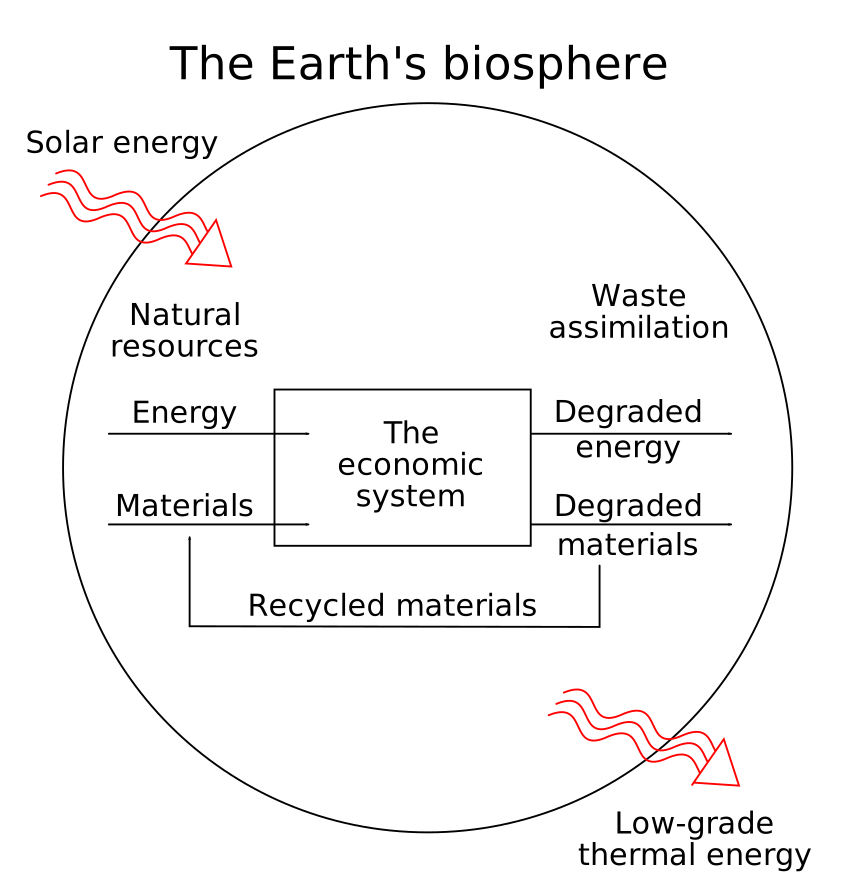
Degrowth operates not as a single prescriptive model, but as a framework for envisioning and enacting a transition away from growth-dependent economies. Policy proposals include implementing a maximum wage and a minimum income. The goal is to achieve a "steady-state economy" or a "post-growth society" where human activities are balanced with ecological regeneration, fostering well-being and social equity.
📊 Key Facts & Numbers
The degrowth movement argues that a reduction of global material and energy use by at least 40% by 2050 is necessary to stay within planetary boundaries. Achieving a degrowth scenario would necessitate a significant shift, potentially involving a reduction in GDP by 20-50% in wealthy nations over a decade, while ensuring that the basic needs of all are met.
👥 Key People & Organizations
Key figures in the degrowth discourse include Serge Latouche, a French economist and anthropologist often credited with popularizing the term. Giorgos Kallis, a professor at the Autonomous University of Barcelona, is a leading academic voice on degrowth. Anitra Nelson and Juliet Schor have also been instrumental in developing and disseminating degrowth ideas, particularly in English-speaking contexts. Prominent organizations and networks advocating for degrowth include the Degrowth International network, which organizes global conferences. Activist groups like Extinction Rebellion and Just Stop Oil, while not exclusively degrowth, share many of its critiques of economic growth and its ecological consequences.
🌍 Cultural Impact & Influence
The degrowth movement has significantly influenced academic discourse, particularly within Ecological Economics, Sustainability Science, and Political Ecology. It has also begun to permeate activist circles and, to a lesser extent, policy discussions, particularly at the local level in some European cities exploring alternatives to GDP growth. The concept has sparked numerous debates in media and public forums, raising awareness about the limitations of perpetual economic expansion. Its ideas have inspired artistic expressions, documentaries, and literature that explore post-growth futures. While direct policy adoption remains limited, the movement's critique of growth has contributed to a broader questioning of dominant economic paradigms, influencing discussions around universal basic income and the circular economy as potential components of a more sustainable future. The "Green New Deal" proposals, while often framed within a growth context, have incorporated some degrowth-adjacent ideas like significant public investment and a focus on social well-being.
⚡ Current State & Latest Developments
The degrowth movement is experiencing a surge in interest, driven by escalating climate impacts and growing dissatisfaction with mainstream economic policies. Several European cities, such as Grenoble and Barcelona, have experimented with degrowth-inspired policies, such as limiting advertising or promoting local currencies. Academic research continues to expand, with new studies exploring the feasibility and social implications of degrowth scenarios. The movement is also grappling with its own internal debates, particularly concerning the balance between radical critique and pragmatic policy engagement, and how to effectively communicate its vision to a broader public. The rise of AI and automation presents new questions for degrowth, potentially offering pathways to reduced labor and increased leisure, or conversely, exacerbating inequality if not managed within a degrowth framework.
🤔 Controversies & Debates
The degrowth movement faces significant controversy and criticism. A primary critique is that it is economically unfeasible and would lead to widespread poverty and unemployment, particularly in less developed nations. Critics, such as proponents of green growth, argue that technological innovation and efficiency gains can decouple economic growth from environmental impact, rendering degrowth unnecessary. There are also concerns about the political feasibility of implementing such radical changes, given entrenched interests and public resistance to perceived austerity. Some critics argue that the movement is overly focused on Western, affluent societies and fails to adequately address the development needs of the Global South. Furthermore, the term "degrowth" itself can be off-putting, leading some to prefer alternative framing like "post-growth" or "a-growth." The potential for degrowth policies to be implemented in authoritarian rather than democratic ways also raises ethical concerns.
🔮 Future Outlook & Predictions
The future outlook for degrowth is complex and contested. Proponents envision a gradual but determined transition towards degrowth societies, potentially accelerated by ecological tipping points or systemic econo
💡 Practical Applications
Degrowth operates not as a single prescriptive model, but as a framework for envisioning and enacting a transition away from growth-dependent economies. Its practical implementation involves a suite of policy proposals aimed at reducing material and energy throughput. These include implementing a maximum wage and a minimum income, reducing working hours to 20-25 hours per week to redistribute work and leisure, investing in public services and commons-based economies, promoting local and regionalized production and consumption, and enacting progressive taxation on resource use and wealth. A core mechanism is the "planned reduction of production and consumption," which distinguishes it from mere recession or economic contraction. This involves democratically deciding which sectors to shrink (e.g., fossil fuels, advertising, fast fashion) and which to expand or maintain (e.g., renewable energy infrastructure, care work, public transport). The goal is to achieve a "steady-state economy" or a "post-growth society" where human activities are balanced with ecological regeneration, fostering well-being and social equity.
Key Facts
- Category
- movements
- Type
- topic