
Contents
Overview
The story of halite is as old as the oceans themselves, a testament to geological processes and the enduring human need for salt. Its formation begins with the evaporation of saline waters, a process that has occurred for billions of years, creating vast underground deposits. The Roman Empire famously built roads, like the Via Salaria, specifically for transporting salt, underscoring its critical role in commerce and sustenance. Early scientific understanding of halite's composition remained elusive until the advent of chemistry, with foundational work in the late 18th century beginning to unravel the elemental nature of sodium and chlorine, the building blocks of this essential mineral. The mineral itself was formally named 'halite' by Carl Friedrich Moses in 1841, solidifying its place in geological nomenclature.
⚙️ How It Works
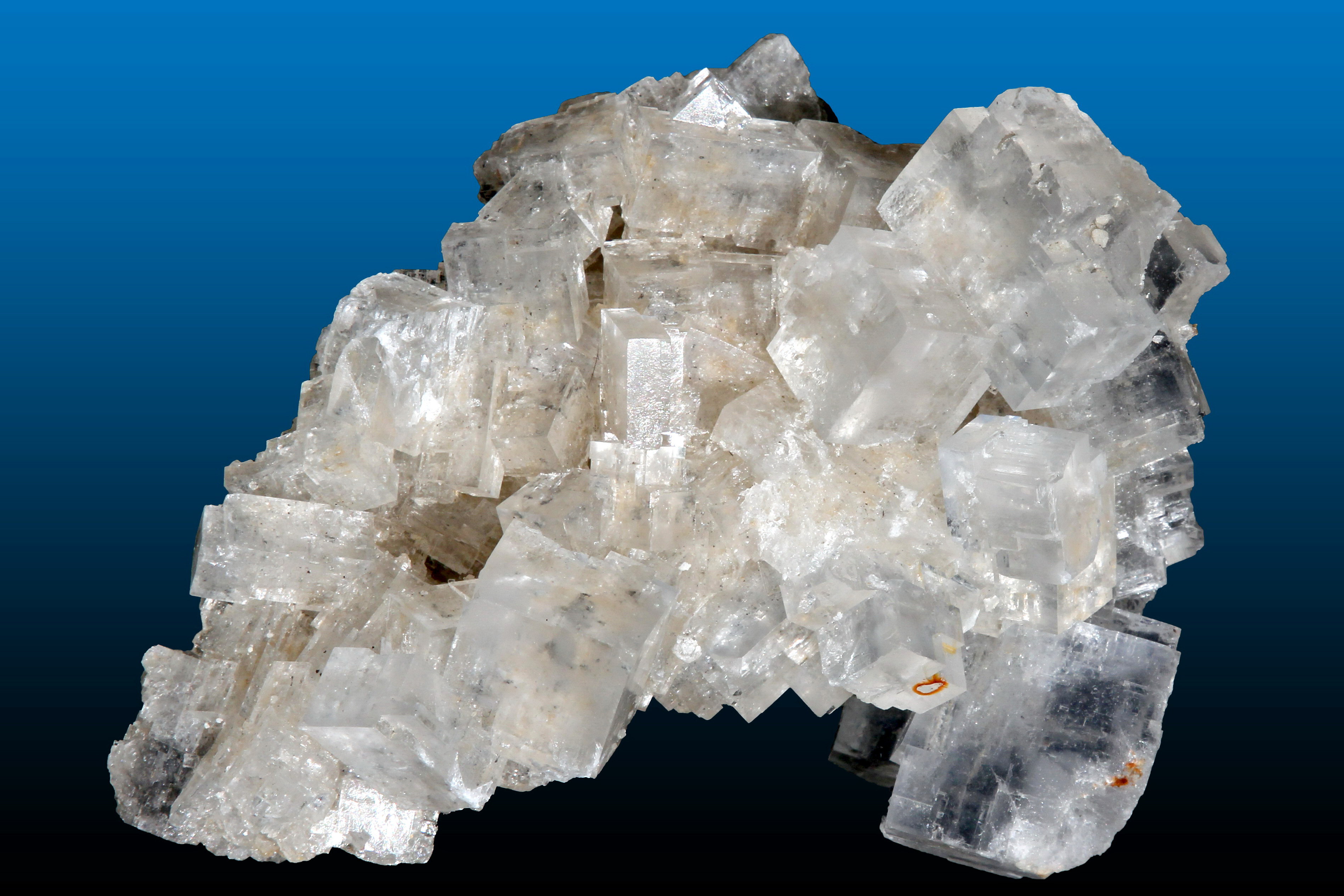
Halite's formation is a direct consequence of evaporation, a fundamental physical process. When bodies of water with high salt concentrations, such as ancient seas or landlocked lakes, lose water to evaporation, the dissolved salts begin to precipitate out of solution. Sodium chloride, with its relatively low solubility compared to some other salts, is a primary mineral to crystallize. Under ideal conditions, halite forms cubic crystals due to the arrangement of sodium (Na+) and chloride (Cl-) ions in a face-centered cubic lattice structure. This ordered atomic arrangement dictates the mineral's characteristic cleavage, allowing it to break cleanly along planes parallel to its crystal faces. The purity and color of halite are heavily influenced by the presence of other dissolved ions and organic matter; for instance, the pink or reddish hues often seen in rock salt can be attributed to microscopic inclusions of halobacteria or iron oxides, while blue coloration can result from specific lattice defects.
📊 Key Facts & Numbers
The scale of halite deposits is staggering, with global reserves estimated to be in the trillions of metric tons, making it one of the most abundant minerals on Earth. The largest producers include China, India, and the United States, each contributing tens of millions of metric tons annually. The economic value of this mineral is immense, with the global salt market projected to reach over $35 billion USD by 2027. Its density averages around 2.17 g/cm³, a key factor in its geological behavior and extraction methods.
👥 Key People & Organizations
While halite is a mineral, its extraction and industrial use involve numerous key organizations and individuals. Major salt-producing companies like Cargill Salt and Compass Minerals operate extensive mining and evaporation facilities worldwide, employing geologists, engineers, and chemists. Historically, figures like Robert Boyle conducted early experiments on the properties of salts, contributing to the scientific understanding that would eventually lead to the precise identification of sodium chloride. In the realm of industrial chemistry, the chlor-alkali process, which uses brine (concentrated NaCl solution) to produce chlorine and sodium hydroxide, is a cornerstone of modern manufacturing, with companies like Dow Chemical and Thyssenkrupp Industrial Solutions being major players in the technology and equipment for this process. The International Salt Company (now part of AkzoNobel) was a significant historical entity in American salt production.
🌍 Cultural Impact & Influence
Halite's influence extends far beyond its geological origins, deeply embedding itself into human culture and civilization. For millennia, salt was a precious commodity, so vital that it was used as currency in some societies, giving rise to terms like 'salary' (from the Latin 'salarium'). Its role in food preservation was revolutionary, enabling long-distance trade and preventing spoilage before refrigeration, thereby shaping diets and economies. Culturally, salt features in religious rituals, folklore, and idioms across the globe, often symbolizing purity, preservation, or hospitality. The iconic image of salt shakers on dining tables worldwide, a practice popularized in the late 19th century, is a daily reminder of its pervasive presence. In literature and art, salt has been used metaphorically to represent essentiality, value, or even desolation, as seen in biblical references or the stark landscapes of salt flats.
⚡ Current State & Latest Developments
In the contemporary world, halite remains a critical industrial commodity, with its extraction and processing continuously evolving. The demand for de-icing salt, particularly in regions with harsh winters, remains a significant driver of production, with companies like Ottawa Valley Salt and American Rock Salt playing key roles in supplying municipalities. Advances in mining technology, including automated extraction and more efficient evaporation techniques, are constantly being developed by firms such as Tenova Mining and Metals. The global salt market is dynamic, influenced by factors like infrastructure development, agricultural needs, and the growth of chemical industries. The environmental impact of large-scale salt extraction, particularly brine disposal from solar evaporation ponds, is an ongoing area of focus for regulatory bodies and industry innovators.
🤔 Controversies & Debates
The extraction and use of halite are not without their controversies. Large-scale solar evaporation ponds, while cost-effective, can have significant environmental impacts, affecting local ecosystems, water tables, and bird populations, as documented in studies concerning facilities in San Diego Bay. The extensive use of road salt for de-icing has raised concerns about its impact on freshwater ecosystems, leading to increased salinity levels in rivers and lakes, and potential damage to roadside vegetation and infrastructure, prompting research into alternative de-icing agents by organizations like the U.S. Environmental Protection Agency. Furthermore, the geopolitical implications of salt resources, particularly in regions with limited access, can sometimes lead to economic tensions, though this is less pronounced than with other strategic minerals.
🔮 Future Outlook & Predictions
The future of halite extraction and utilization is likely to be shaped by a confluence of technological innovation and environmental stewardship. As climate change impacts weather patterns, the demand for de-icing salt may fluctuate, potentially increasing in some regions while decreasing in others. Innovations in brine management and the development of more sustainable evaporation techniques will be crucial for mitigating environmental concerns. Furthermore, the chemical industry's reliance on sodium chloride as a feedstock for the chlor-alkali process ensures its continued importance, with research focusing on energy efficiency and the capture of byproducts. The potential for halite as a material for carbon capture and storage is also being explored, leveraging its porous structure and chemical properties. The development of advanced geological surveying techniques will likely uncover new, economically viable halite deposits globally.
💡 Practical Applications
Halite's practical applications are remarkably diverse, spanning essential human needs and complex industrial processes. Its primary use is as a food additive and preservative, enhancing flavor and extending shelf life for countless products. In winter maintenance, it is indispensable for de-icing roads, runways, and sidewalks, significantly improving safety and mobility. Industrially, halite is the fundamental raw material for the chlor-alkali process, which produces chlorine gas (used in PVC, disinfectants) and sodium hydroxide (caustic soda, used in paper, textiles, and soaps). It also serves as a component
Key Facts
- Category
- nature
- Type
- topic