
Contents
Overview
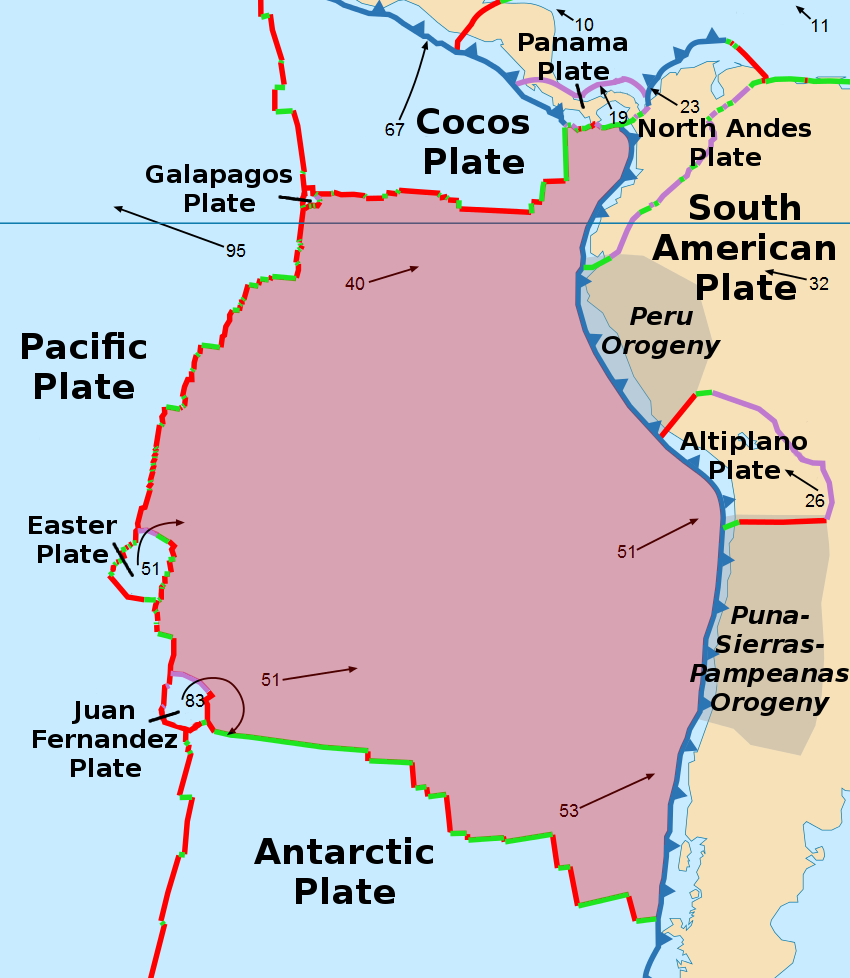
The Nazca Plate, an oceanic tectonic plate situated in the eastern Pacific Ocean, is a dynamic geological force primarily recognized for its relentless subduction beneath the South American Plate. This process, occurring along the Peru-Chile Trench, is the principal architect of the towering Andes Mountains and the region's significant seismic and volcanic activity. Named after the Nazca region of southern Peru, this relatively young plate, formed from the fragmentation of the ancient Farallon Plate approximately 23 million years ago, boasts some of the youngest oceanic crust, with its oldest rocks dating back around 50 million years. Its western boundary is defined by the Pacific Plate, and its southern edge by the Antarctic Plate, with the East Pacific Rise and Chile Rise acting as key transform fault boundaries. The Nazca Plate's movement over underlying mantle hotspots has sculpted volcanic islands and seamount chains, adding further complexity to its geological narrative and its profound impact on South America's topography and natural hazards.
🎵 Origins & History
The story of the Nazca Plate is intrinsically linked to the dramatic breakup of the much larger Farallon Plate, a colossal oceanic plate that once dominated the Pacific basin. This fragmentation, which began tens of millions of years ago, led to the formation of several smaller plates, including the Nazca Plate, around 23 million years ago. Its existence as an independent entity is geologically recent, a stark contrast to older, more stable oceanic plates. The oldest rocks found on the Nazca Plate are approximately 50 million years old, indicating a relatively youthful crust compared to other oceanic plates. The University of Chile and the Geophysical Institute of Peru are key institutions that have extensively studied its origins and behavior.
⚙️ How It Works
The primary mechanism defining the Nazca Plate's behavior is subduction. As this dense oceanic plate converges with the lighter continental South American Plate, it is forced downward into the Earth's mantle beneath the Peru-Chile Trench. This descent is not smooth; the plate bends and breaks, generating immense friction and stress, which are released as powerful earthquakes, including some of the largest recorded on Earth, such as the 1960 Valdivia earthquake. As the Nazca Plate sinks, it heats up, releasing water and causing the overlying mantle wedge to melt. This molten rock, or magma, rises to the surface, erupting to form the volcanic arcs that characterize the Andes Mountains, a direct consequence of this ongoing geological dance. The National Geographic Society has produced numerous documentaries illustrating this process.
📊 Key Facts & Numbers
The Nazca Plate covers an estimated area of approximately 15.6 million square kilometers, making it one of the larger oceanic plates. Its convergence rate with the South American Plate varies across its length, averaging around 7 to 10 centimeters per year in the central section. This rapid movement contributes to the high seismic hazard in countries like Chile, Peru, and Ecuador. The deepest part of the Peru-Chile Trench, where subduction occurs, reaches depths of over 8,000 meters. The plate's oldest crustal rocks are estimated to be around 50 million years old, while the youngest seafloor spreading occurs at the East Pacific Rise and Chile Rise boundaries. The total volume of the Nazca Plate is estimated to be in the order of 10^17 cubic meters.
👥 Key People & Organizations
While tectonic plates are natural phenomena, their study involves numerous geoscientists and institutions. Key figures in understanding plate tectonics, whose work informs our knowledge of the Nazca Plate, include Alfred Wegener, the proponent of continental drift, and later researchers like Harry Hess, who developed the theory of seafloor spreading. Organizations such as the United States Geological Survey, the Lamont-Doherty Earth Observatory at Columbia University, and national geological surveys in South America play crucial roles in monitoring seismic activity and mapping the plate's boundaries. The International Union of Geodesy and Geophysics facilitates global collaboration in this field. Research expeditions often involve vessels like the R/V Roger Revelle.
🌍 Cultural Impact & Influence
The most profound cultural impact of the Nazca Plate is its direct role in shaping the geography and human history of western South America. The Andes Mountains, a direct result of its subduction, have served as both a barrier and a cradle for civilizations, influencing migration patterns and resource distribution, and the development of distinct cultures like the Inca Empire. The region's high volcanic and seismic activity has also deeply influenced local folklore, religious beliefs, and disaster preparedness strategies. For instance, the ancient Nazca Lines in Peru, while their exact purpose remains debated, are situated within the geographical zone profoundly affected by the plate's activity. Modern societies in countries like Chile and Peru live with the constant awareness of the plate's power, influencing urban planning and emergency response protocols, as documented by organizations like the Red Cross.
⚡ Current State & Latest Developments
The Nazca Plate continues its inexorable journey beneath South America, driving ongoing geological processes. Current research focuses on refining models of its subduction dynamics, particularly the behavior of the plate at greater depths and its interaction with mantle plumes. Advanced seismic imaging techniques, such as those employed by the EarthScope Project, provide unprecedented views into the Earth's interior, revealing details about the plate's structure and deformation. Monitoring stations operated by agencies like the National Earthquake Information Center (NEIC) continuously track seismic events, providing crucial data for hazard assessment. The plate's interaction with the Antarctic Plate at the Chile Rise is also an area of active investigation, shedding light on complex plate boundary interactions.
🤔 Controversies & Debates
A significant debate revolves around the precise age and fragmentation history of the Nazca Plate and its relationship to the broader breakup of the Farallon Plate. While the 23-million-year figure for its independent existence is widely cited, some studies suggest earlier or more complex separation processes. Another area of discussion concerns the exact mechanisms driving the varying subduction rates along the Peru-Chile Trench, with debates on the influence of mantle dynamics versus plate boundary forces. Furthermore, the long-term implications of the Nazca Plate's subduction on the stability and future evolution of the South American continent are subjects of ongoing geological modeling and speculation, with some geophysicists positing potential future continental rifting events.
🔮 Future Outlook & Predictions
The future of the Nazca Plate promises continued geological dynamism. As it continues to subduct, the Andes Mountains will likely grow taller, and volcanic activity will persist. Scientists predict that over millions of years, the Nazca Plate will be almost entirely consumed into the mantle. This process could eventually lead to significant changes in the plate tectonic configuration of the Pacific basin, potentially influencing the formation of new plate boundaries or the reshaping of existing ones. Some models suggest that the ongoing subduction may eventually lead to the formation of a new triple junction further north along the South American coast, altering the distribution of seismic and volcanic hazards. The Future of Life Institute has highlighted the long-term geological forces that shape our planet.
💡 Practical Applications
While the Nazca Plate itself is not directly 'applied' in a technological sense, its geological processes have significant practical implications. The rich mineral deposits and metal ores found in the Andes, such as copper and gold, are largely a product of the volcanic and hydrothermal activity associated with the plate's subduction. Understanding the plate's seismic behavior is critical for earthquake engineering and disaster risk reduction in densely populated coastal cities like Lima and Santiago. Geothermal energy potential in volcanic regions is also directly linked to the subduction process. Furthermore, the study of the Nazca Plate contributes to fundamental geological knowledge used in resource exploration and hazard assessment worldwide, informing the work of companies like ExxonMobil in their geological surveys.
Key Facts
- Category
- nature
- Type
- topic