
Contents
Overview
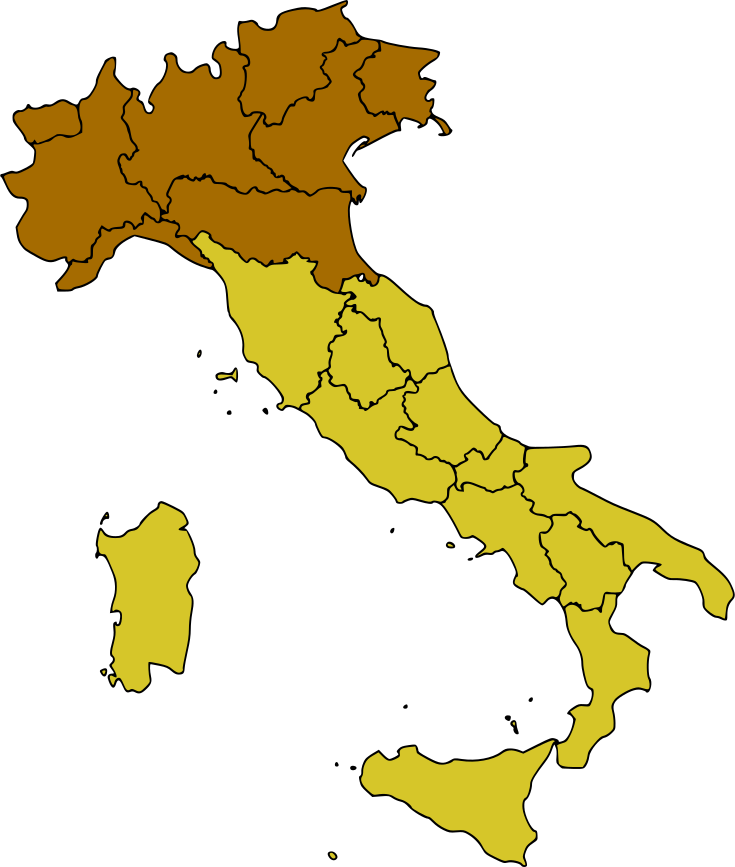
The concept of 'Northern Italy' emerged gradually through centuries of political and economic divergence from the south. Historically, the region was a patchwork of powerful city-states and duchies, including the Republic of Venice, the Duchy of Milan, and the Republic of Genoa, each with its own governance and economic focus. The unification of Italy occurred in 1861, spearheaded by figures like Count Camillo Benso di Cavour from Piedmont, who was a principal architect of Italian unification, bringing these disparate territories under a single crown, but regional identities remained potent. Post-unification, Northern Italy rapidly industrialized, driven by its proximity to European markets and its robust banking and manufacturing sectors, a trajectory that significantly widened the economic gap between the North and the less developed South, a phenomenon often referred to as the Questione Meridionale. The administrative definition of Northern Italy by ISTAT formalized this geographical and statistical grouping, acknowledging its unique socio-economic profile.
⚙️ How It Works
Northern Italy functions as the engine of the Italian economy, characterized by a highly diversified industrial base and advanced service sectors. Its economic prowess is built upon key industries such as automotive manufacturing (home to FIAT and Ferrari), fashion and luxury goods (with Milan as a global capital for fashion weeks and brands like Prada and Giorgio Armani), advanced machinery, and a significant agricultural sector, particularly in the Po Valley. The region's infrastructure, including high-speed rail networks and major ports like Genoa, facilitates trade and connectivity. Its governance is a complex interplay between national Italian law and regional administrative bodies, each responsible for areas like education, healthcare, and local economic development, with significant autonomy granted to regions like Aosta Valley due to its linguistic minority status.
📊 Key Facts & Numbers
As of 2025, Northern Italy is home to approximately 27.8 million people, making it the most populous part of the country. This population density translates into significant economic output, with the region's GDP estimated at €1 trillion in 2021, accounting for a commanding 56.5% of Italy's total economic activity. The region covers 120,260 square kilometers, roughly 40% of Italy's total area. Within this region, metropolitan areas like Milan and Turin are major economic hubs, with Milan's metropolitan area alone contributing a substantial portion to the national GDP. Northern Italy also boasts a remarkable concentration of cultural heritage, with 37 of Italy's 59 UNESCO World Heritage Sites located within its borders, underscoring its historical and artistic significance.
👥 Key People & Organizations
Key figures instrumental in shaping Northern Italy's identity include Count Camillo Benso di Cavour, a 19th-century statesman from Piedmont who was a principal architect of Italian unification. In the industrial realm, figures like Giovanni Agnelli Sr., founder of FIAT in 1899, transformed Turin into an industrial powerhouse. Culturally, artists like Leonardo da Vinci, who spent his final years in France but significantly influenced Italian Renaissance art and science, and composers such as Giuseppe Verdi, whose operas are deeply tied to Italian national identity, represent the region's artistic legacy. Major organizations driving its economy include ISTAT for statistical definition, the Confindustria (Italian Employers' Federation), and influential regional governments like the Lombardy Region and the Veneto Region.
🌍 Cultural Impact & Influence
Northern Italy's cultural output has profoundly influenced global aesthetics, design, and cuisine. Milan's status as a fashion capital, established through events like Milan Fashion Week since the 1950s, dictates global trends in apparel and accessories, championed by designers such as Giorgio Armani and Gianni Versace. The region's culinary traditions, from risotto alla Milanese to Prosciutto di Parma, are celebrated worldwide and have shaped international perceptions of Italian food. Furthermore, its contributions to art and architecture, evident in sites like St. Peter's Basilica (though technically Vatican City, its influence is tied to Italian Renaissance masters) and the Doge's Palace in Venice, continue to inspire architects and artists globally. The linguistic diversity, with Lombard and Venetian languages still spoken, adds another layer to its rich cultural tapestry.
⚡ Current State & Latest Developments
In 2024-2025, Northern Italy continues to grapple with the challenges of maintaining its economic dominance while addressing regional disparities and adapting to global economic shifts. The ongoing debate around regional autonomy remains a significant political undercurrent, particularly in regions like Veneto and Lombardy, which have pushed for greater self-governance. The region is also at the forefront of Italy's efforts to transition towards a greener economy, with significant investments in renewable energy and sustainable manufacturing. The aftermath of the COVID-19 pandemic continues to shape its economic recovery, with a focus on digital transformation and supply chain resilience, particularly in sectors like automotive and advanced manufacturing.
🤔 Controversies & Debates
A persistent controversy surrounding Northern Italy is the economic and social divide with the southern regions, often termed the 'Southern Question'. Critics argue that historical policies and ongoing economic imbalances have perpetuated this disparity, leading to significant internal migration and political tension. Another point of contention is the push for greater regional autonomy, particularly from parties like the Lega, which some view as a threat to national unity, while proponents see it as a necessary step towards more efficient governance tailored to local needs. Debates also arise around the preservation of distinct regional languages and cultures versus the promotion of a unified Italian identity, especially in areas with strong Rhaeto-Romance linguistic minorities like South Tyrol.
🔮 Future Outlook & Predictions
The future outlook for Northern Italy hinges on its ability to innovate and adapt. Projections suggest continued leadership in high-value manufacturing and design, with a growing emphasis on the digital economy and AI integration into industrial processes. The region is poised to play a key role in Europe's green transition, leveraging its industrial capacity for renewable energy technologies and sustainable infrastructure projects. However, demographic challenges, including an aging population and declining birth rates, could temper growth if not addressed through immigration policies and social reforms. The success of initiatives like the National Recovery and Resilience Plan (PNRR), funded by the European Union, will be crucial in determining its trajectory towards modernization and competitiveness by 2030.
💡 Practical Applications
Northern Italy's practical applications are vast, underpinning much of Italy's global economic standing. Its industrial heartland is a hub for producing high-quality goods, from the Lamborghini supercars manufactured in Emilia-Romagna to the precision machinery developed in Lombardy. The region is a critical node in global supply chains for sectors like fashion, food processing, and automotive. Furthermore, its rich cultur
Key Facts
- Category
- culture
- Type
- topic