
Contents
- 🎵 Origins & History
- ⚙️ How It Works
- 📊 Key Facts & Numbers
- 👥 Key People & Organizations
- 🌍 Cultural Impact & Influence
- ⚡ Current State & Latest Developments
- 🤔 Controversies & Debates
- 🔮 Future Outlook & Predictions
- 💡 Practical Applications
- 📚 Related Topics & Deeper Reading
- Frequently Asked Questions
- References
- Related Topics
Overview
The concept of quarks emerged in 1964, proposed independently by physicists Murray Gell-Mann and George Zweig. Gell-Mann, working at the California Institute of Technology, initially conceived of three types of particles—dubbed "quarks" from a line in James Joyce's novel Finnegans Wake—to explain the observed patterns in the proliferation of subatomic particles discovered in the mid-20th century. Zweig, at CERN, independently developed a similar three-quark model. Early experimental evidence supporting their existence came from deep inelastic scattering experiments at the Stanford Linear Accelerator Center (SLAC) in 1968, where electrons were observed to scatter off point-like structures within protons and neutrons, strongly suggesting the presence of smaller, constituent particles. The subsequent discovery of the charm quark in 1974 at Brookhaven National Laboratory and the bottom quark in 1977 at Fermilab solidified the quark model and led to the proposal of a fourth quark flavor, charm, and later the top and bottom quarks, expanding the model to six flavors.
⚙️ How It Works
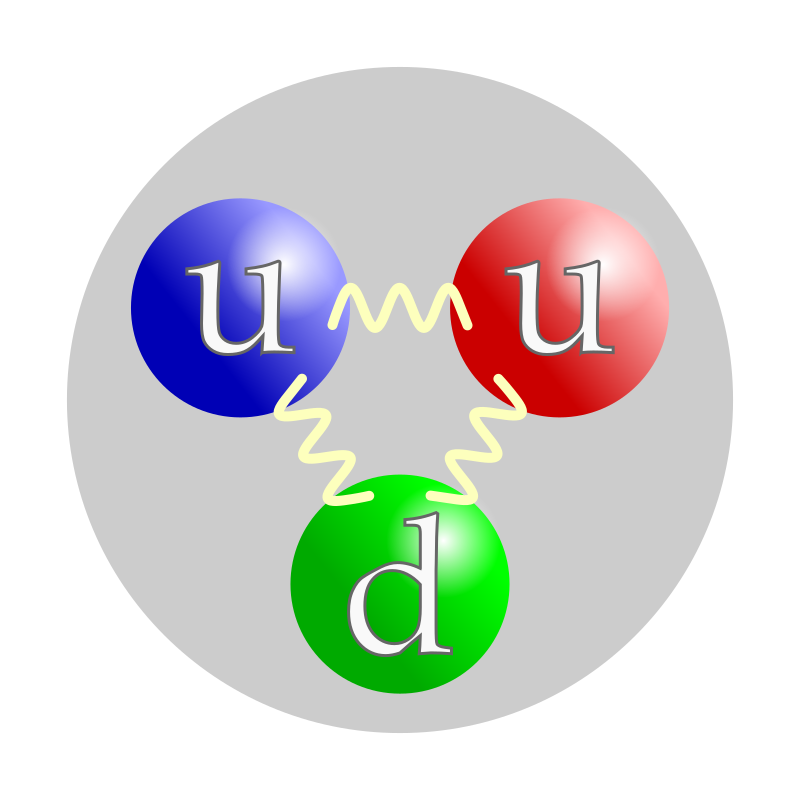
Quarks are fundamental fermions with spin 1/2, meaning they obey the Pauli exclusion principle. They possess fractional electric charges, unlike the integer charges of protons and electrons. For instance, up, charm, and top quarks carry a charge of +2/3, while down, strange, and bottom quarks carry a charge of -1/3. Crucially, quarks also carry a property called "color charge"—red, green, or blue—which is the source of the strong nuclear force mediated by gluons. This force is so powerful that it prevents quarks from being isolated; they are always found in color-neutral combinations, either as baryons (three quarks, one of each color) or mesons (a quark and an antiquark, with complementary colors). The mass of quarks varies dramatically, from the very light up and down quarks to the extremely massive top quark.
📊 Key Facts & Numbers
The lightest quarks, up and down, have masses of approximately 2.2 MeV/c² and 4.7 MeV/c², respectively. The top quark, discovered in 1995 at Fermilab, is the heaviest known elementary particle, with a mass of about 173 GeV/c², roughly the mass of a gold atom. There are three "generations" of quarks, with each successive generation being significantly more massive. The up and down quarks form the first generation, making up protons and neutrons. The charm and strange quarks form the second generation, and the top and bottom quarks constitute the third and heaviest generation. The energy required to probe these particles has led to the construction of massive particle accelerators, with CERN's Large Hadron Collider (LHC) being the most powerful, capable of colliding particles at energies up to 13.6 TeV.
👥 Key People & Organizations
Key figures in the development of the quark model include Murray Gell-Mann, who coined the term and proposed the initial three-quark model, and George Zweig, who independently developed a similar concept. Experimental validation was significantly advanced by physicists like Jerome Friedman, Henry Kendall, and Richard Taylor, who were awarded the Nobel Prize in Physics in 1990 for their work on deep inelastic scattering experiments at SLAC. Major research institutions instrumental in quark physics include CERN, home to the LHC, and Fermilab, where the top quark was discovered. The Particle Data Group (PDG) plays a crucial role in compiling and evaluating experimental data on elementary particles, including quarks, providing a consensus view of their properties.
🌍 Cultural Impact & Influence
The quark model has profoundly influenced our understanding of the universe's fundamental constituents, forming a bedrock of the Standard Model of particle physics. Its conceptual framework has permeated scientific thought, influencing fields from nuclear physics to cosmology. The idea of fundamental particles combining to form more complex structures is a recurring theme in science, echoing earlier discoveries like atoms forming molecules. The abstract nature of quarks, particularly their "color charge" and confinement, has also captured the public imagination, appearing in science fiction and popular science discussions about the nature of reality. The quest to understand these elusive particles has driven technological innovation in particle accelerators and detectors, with applications extending beyond fundamental research.
⚡ Current State & Latest Developments
Current research continues to probe the properties of quarks with unprecedented precision, particularly at the Large Hadron Collider (LHC) at CERN. Experiments like ATLAS and CMS are investigating the behavior of quarks in high-energy collisions, searching for deviations from the Standard Model and exploring phenomena like quark-gluon plasma. Recent analyses have focused on precisely measuring the masses of the top and bottom quarks and studying their interactions with the Higgs boson. There's also ongoing interest in understanding the subtle differences between matter and antimatter, which may be related to the behavior of quarks and their antiparticles, antiquarks. The development of new theoretical frameworks, such as Quantum Chromodynamics (QCD) at high temperatures and densities, aims to better describe quark behavior in extreme conditions.
🤔 Controversies & Debates
One of the most significant ongoing debates in particle physics revolves around the precise mass of the top quark, with different experimental measurements showing slight discrepancies that challenge the Standard Model's predictive power. Another area of contention is the "proton radius puzzle," which involves conflicting measurements of the proton's size, potentially hinting at new physics beyond the Standard Model or issues with our understanding of quark interactions within the proton. The phenomenon of color confinement itself, while experimentally well-established, remains a complex theoretical challenge, with ongoing efforts to fully understand its mathematical underpinnings within Quantum Chromodynamics. The existence of free quarks, though widely believed to be impossible, is a theoretical frontier that some researchers continue to explore, albeit with little experimental support.
🔮 Future Outlook & Predictions
Future research will likely focus on refining measurements of quark properties, particularly the masses and mixing parameters of the heavier quarks, to search for subtle signs of new physics. The Future Circular Collider (FCC) and International Linear Collider (ILC) are proposed next-generation particle accelerators designed to explore physics at even higher energies and luminosities, potentially revealing new quark flavors or interactions. Theoretical physicists are also exploring extensions to the Standard Model, such as Supersymmetry (SUSY) and theories of extra dimensions, which could offer new explanations for the observed quark spectrum and mass hierarchy. Understanding the role of quarks in the early universe, particularly during the Big Bang, and their connection to the matter-antimatter asymmetry remains a key long-term goal.
💡 Practical Applications
While quarks are not directly manipulated in everyday applications due to color confinement, their properties are fundamental to technologies that rely on understanding nuclear physics and particle interactions. The development of particle accelerators, driven by the need to study quarks, has led to advancements in medical imaging (e.g., PET scans) and cancer treatment (e.g., proton therapy). The theoretical framework of Quantum Chromodynamics underpins our understanding of nuclear forces, which is crucial for nuclear energy and materials science. Furthermore, the sophisticated detectors developed for particle physics experiments have found applications in various fields, including security screening and industrial quality control. The ongoing research into quark-gluon plasma also informs our understanding of extreme states of matter relevant to astrophysics.
Key Facts
- Year
- 1964 (proposal)
- Origin
- United States / Switzerland
- Category
- science
- Type
- concept
Frequently Asked Questions
What exactly is a quark?
A quark is a fundamental elementary particle, meaning it's not made up of smaller components. They are the basic building blocks of matter, alongside leptons like electrons. Quarks possess intrinsic properties such as spin, electric charge (which is fractional, unlike the integer charges of protons and electrons), and a unique property called color charge. This color charge is the source of the strong nuclear force, which binds quarks together. There are six known types, or "flavors," of quarks: up, down, charm, strange, top, and bottom, organized into three generations.
Why can't we see individual quarks?
Quarks are never observed in isolation due to a phenomenon called color confinement, a direct consequence of the strong nuclear force. This force, mediated by gluons, becomes stronger as quarks are pulled apart, much like a rubber band that snaps back if stretched too far. Instead, quarks are always found bound together in composite particles called hadrons. The most common hadrons are baryons, like protons and neutrons (each made of three quarks), and mesons (made of a quark and an antiquark). Trying to isolate a quark requires so much energy that it simply creates more quark-antiquark pairs, which then form new hadrons.
What are the different types of quarks and their significance?
There are six flavors of quarks: up, down, charm, strange, top, and bottom. The up and down quarks are the lightest and most stable, forming protons (two up, one down) and neutrons (one up, two down), which constitute the nuclei of atoms. The charm and strange quarks are heavier and less stable, found in exotic particles. The top and bottom quarks are the heaviest, with the top quark being the most massive elementary particle known. Their discovery and study have been crucial for validating and refining the Standard Model of particle physics, providing insights into fundamental forces and particle interactions.
How were quarks discovered and proven to exist?
The quark model was first proposed in 1964 by Murray Gell-Mann and George Zweig to explain the growing zoo of subatomic particles. Direct experimental evidence came from deep inelastic scattering experiments at Stanford Linear Accelerator Center (SLAC) in 1968, where electrons were fired at protons and neutrons. The way the electrons scattered suggested they were hitting smaller, point-like constituents within the protons and neutrons, which were identified as quarks. Subsequent discoveries of heavier quarks, like the charm (1974) and top (1995), further solidified the quark model and its place in the Standard Model.
What is the role of color charge and gluons?
Color charge is a property of quarks analogous to electric charge, but it comes in three types: red, green, and blue (these are just labels, not actual colors). The strong nuclear force, responsible for binding quarks together, is mediated by particles called gluons. Gluons carry color charge themselves and interact with quarks, transferring color and binding them into color-neutral combinations (hadrons). The complex interactions between quarks and gluons are described by Quantum Chromodynamics (QCD), a fundamental theory in particle physics. The strength of the strong force, governed by these interactions, is what leads to color confinement.
Are quarks used in any practical technologies?
Due to color confinement, individual quarks cannot be directly harnessed or manipulated for practical applications. However, the study of quarks has indirectly led to significant technological advancements. The development of powerful particle accelerators like the Large Hadron Collider (LHC) for quark research has spurred innovations in areas such as medical imaging (e.g., PET scans) and cancer therapy (e.g., proton therapy). The theoretical understanding derived from quark physics also underpins nuclear energy and materials science. Furthermore, the sophisticated detector technologies developed for particle physics experiments have found uses in various industries, from security to quality control.
What are the biggest mysteries or future research directions concerning quarks?
Several profound mysteries remain regarding quarks. Scientists are still working to precisely measure the masses of quarks, especially the top quark, as discrepancies could point to physics beyond the Standard Model of particle physics. The proton radius puzzle, a discrepancy in measurements of the proton's size, may also be linked to quark interactions. Understanding the fundamental nature of color confinement and the exact mechanism behind the matter-antimatter asymmetry in the universe, which might involve quark behavior, are major long-term goals. Future experiments at next-generation colliders aim to shed light on these questions.